
Documentation » Using MailHawk
Review quarantined emails
On this page
Found an email waiting for review? MailHawk holds emails to risky recipients so you can check them before sending. Release a legitimate message, trust an appropriate address, or reject the held copy.
A hold is not a delivery failure. MailHawk assesses each recipient separately. If only some recipients are risky, only those are held in a separate entry, and the others are sent their copy right away. Always check the recipients on the held entry before acting.
Review a held email
- As an administrator, go to Tools > MailHawk > Email Log.
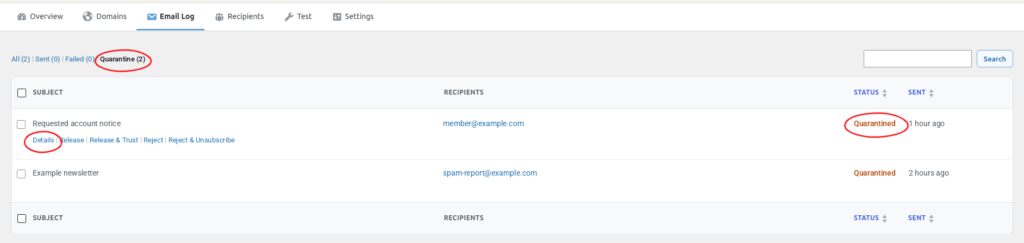
- Choose the Quarantine filter. Held rows show Quarantined in the Status column.
- Hover over a message’s subject and click Details.
- Check its recipients, sender, subject, and content. Is the address correct, and is this a message the person expects? Review consent and delivery history before deciding.
The examples below are illustrations, not real held messages. The account notice and newsletter are separate entries, not two parts of a single message.
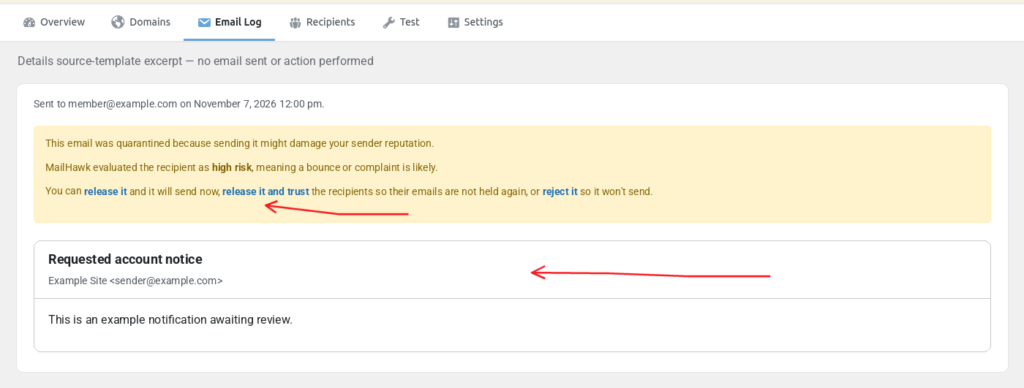
Details shows a warning and the message preview. The warning is the same general explanation for every held email, not a list of the risk factors for this recipient. Its Sent to wording also appears on held messages; it identifies the stored recipients, not proof that the email was sent.
When an email is held, MailHawk schedules a reminder to the WordPress administration email address, about 10 minutes later and at most once a day. Its subject starts with Action Required, and it is skipped if nothing is still waiting. Scheduled tasks and delivery can delay it, so you can review Quarantine without waiting for it.
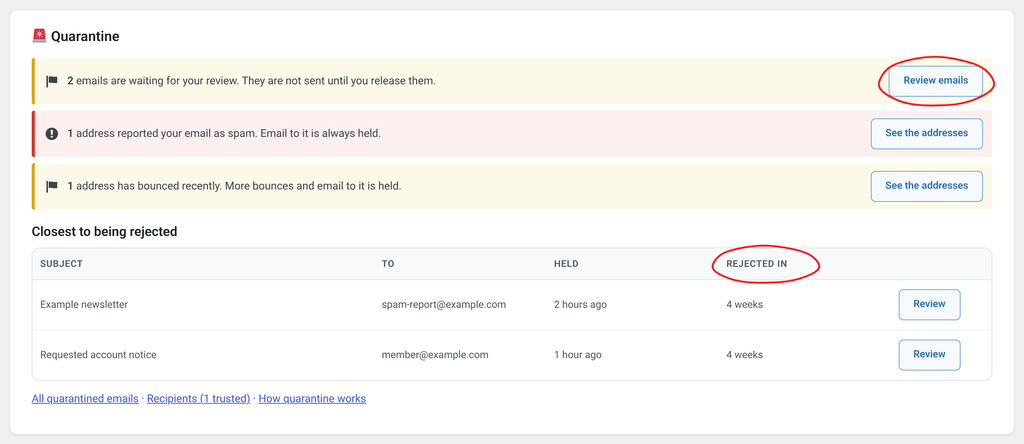
The Overview also shows a Quarantine card when emails are waiting, or addresses need attention. It counts held emails, emails that will be rejected automatically within 7 days, and addresses that reported spam or bounced recently. Its Closest to being rejected table shows when each held email will be deleted.
Choose an action deliberately
- Release: sends this held copy now, without the risk check and without granting lasting trust.
- Release & Trust: sends first, then trusts the recipients of that held copy if the send succeeds. An address that reported spam is never trusted. Only use it for addresses you have checked and genuinely expect to receive future mail.
- Reject: deletes the held entry without sending it. There is no Rejected status to return to later. It does not unsubscribe the person.
- Reject & Unsubscribe: appears when Groundhogg is active. It rejects the held copy and unsubscribes matching Groundhogg contacts. It is not a universal unsubscribe for every plugin and does not delete MailHawk’s remembered complaint record.
These are actions, not previews. They run as soon as you click, with no confirmation step.

These actions affect every recipient stored in the selected held entry. Release & Trust is not an address picker: it trusts all eligible recipients of that copy. Reject & Unsubscribe affects all matching contacts in that copy. For a split message, releasing the held entry does not resend the separate copy already sent to other recipients.
The same actions are also available under Bulk actions. Review every selected entry first; do not bulk-trust a queue just to empty it. Entries that are no longer quarantined are skipped, so nothing is sent twice, and rejecting an entry cannot recall copies already sent to other recipients.
After a release, check the resulting status and any errors in Email Log details. If the send fails, the entry is no longer quarantined: it shows Failed with the reason, and you can retry it from the Failed filter. Sent means accepted for sending, not confirmed inbox delivery. Trust does not guarantee delivery; verify a mailbox or provide marketing consent.
Spam complainants are never eligible for trust
Check Recipients for bounce history and Reported spam records before choosing to trust an address. In the illustration below, one address has a spam complaint, one has three bounces and is being watched, and one is trusted. The address that reported spam has no Remove button.
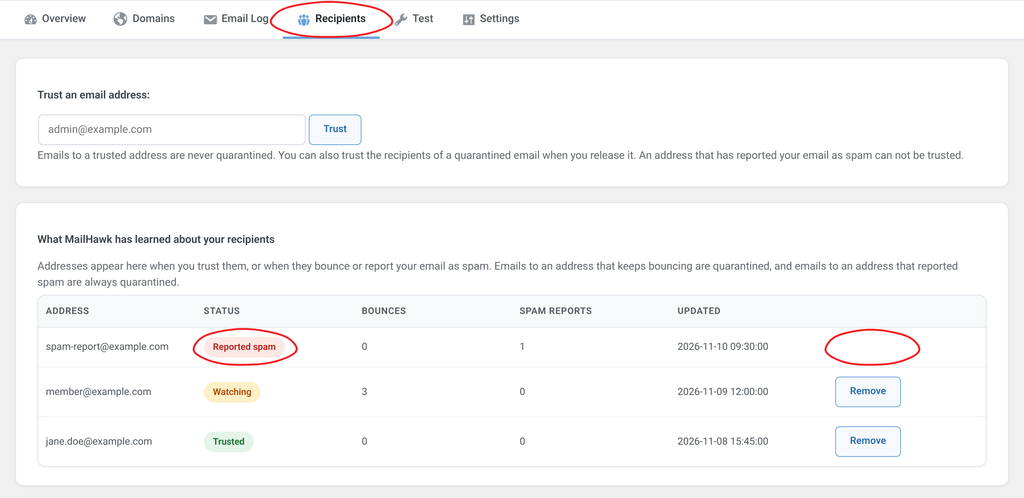
A complainant’s held email may still be released, but the address must never be treated as trusted. Email to an address that reported spam is always held, and a complaint prevents trust, even with Release & Trust or the Trust form. Release is still a real sending attempt, and the service may suppress it. Do not use any release action to resume unwanted marketing.
The complaint record is kept on purpose. Recipients have no Remove button for an address that reported spam, and MailHawk keeps the record even if you try to remove it another way: That person reported email from this site as spam. The record is kept so they are not emailed again. Do not re-add or re-subscribe a complained-about address as a workaround. Contact support about a disputed complaint.
Removing any other row erases what MailHawk learned about the address, including its bounce history or trust, and it is then treated like any other address. Only do this when you know the problem is fixed.
Why was the email held?
MailHawk holds an email when its assessed recipient risk is five or more. Provider weights are one input, not a diagnosis by themselves. The bundled list assigns gmail.com 2, yahoo.com 3, sbcglobal.net 5, and netscape.net 5. These are configured weights, not current measured rejection rates or a statement that a provider is unavailable. Weights can change with updates.
An ordinary custom business domain starts with a provider weight of zero, not necessarily a total risk of zero. An associated WordPress user reduces the score. The local check gives the site’s administration email address and addresses on the site’s exact hostname, zero risk. None of these rules provides marketing consent or guarantees service-side delivery.
Trusted addresses skip the local risk check while trust remains. You can use Release & Trust after reviewing held mail, or the Trust form on Recipients. Neither works for an address that reported spam. A hard bounce removes trust and adds risk, and repeated bounces add more: two recent bounces are usually enough to hold mail to an address. By default, bounce risk ages out 90 days after the latest bounce, without erasing the record or proving the mailbox is valid.
Only a rejection from the recipient’s mail server counts as a bounce against the address. Failures on MailHawk’s side, such as timeouts, rate limits, or a cancelled hold at the service, do not count, so an outage can’t put good addresses in quarantine. An email whose hold was cancelled at the service shows as Failed in the log.
With Groundhogg and a matching contact, role inboxes such as info@, support@ and sales@ add risk, as does a name that doesn’t match the address and a lack of recent opens or clicks. A name matching the address, recent page visits, opens, and clicks reduce it. The assessment is cached for up to a week by default and recalculated when needed after expiry. New contacts get a default 30-day grace period for lack of opens/clicks only, not immunity from other risk or complaints.
Before importing a large list, an address-verification tool such as ZeroBounce can help identify stale or invalid addresses. Check your privacy obligations before uploading contact data. Verification is not consent and does not justify deleting complaint records. Regularly remove inactive subscribers from marketing audiences while retaining necessary suppression records.
How long are held emails kept?
Held messages remain in the log even when Disable email logging is on. By default, they are kept for at least 30 days, or the Log retention period if longer. Customizations can change this period. The Overview’s Rejected In column and the reminder email show how long you have.
Scheduled cleanup deletes expired held entries without sending them. Reject also deletes the entry. A release or retry updates the entry’s date, so the retention clock starts again from that attempt; check the resulting entry rather than relying on its original hold date.
Can I turn quarantine off?
No. There is no setting to disable quarantine or change its threshold, because the review protects the sending reputation that all MailHawk customers share. Keep your list current, investigate questionable addresses, and collect clear consent. Do not trust an imported list simply to clear a large queue.
Want to see a hold for yourself? Email to any address containing +test-quarantine@, for example admin+test-quarantine@example.com, is always held. Reject the test entry afterwards.
Still stuck? Open a support ticket and we will help.